
Bitcoin’s Journey From $0 to $120,000 — And Why Its Structure Still Separates It From Every Other Coin
How fixed supply, halving cycles, and institutional inflows transformed Bitcoin from an experiment into the world’s first decentralized monetary asset
Bitcoin did not rise to six-figure valuations because it was the fastest blockchain, the cheapest network, or the most aggressively marketed asset.
It rose because it solved something deeper — the problem of trust.
For the first time in financial history, an asset existed whose supply, issuance, and ownership could not be altered by governments, corporations, founders, or insiders. Its rules were written in code and enforced by a decentralized global network.
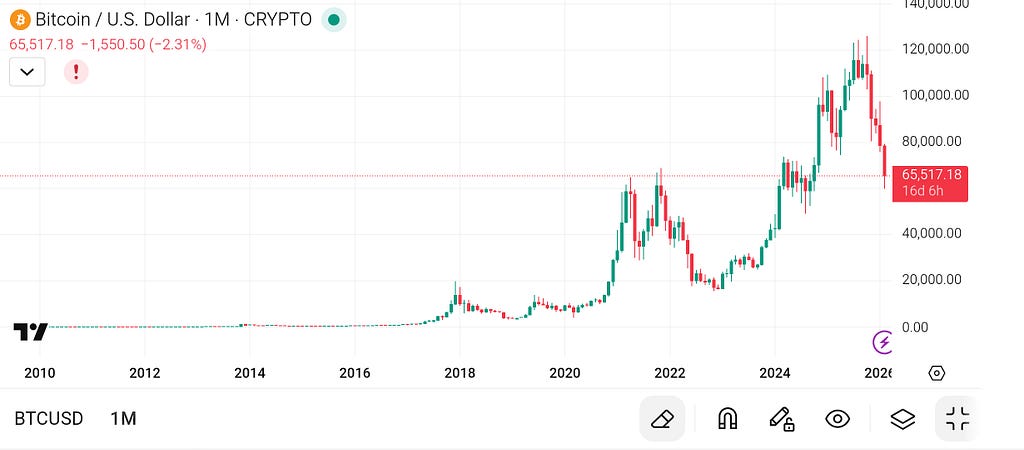
Every price movement since — from $0 to $120,000 and back to corrections near $60,000 — reflects the market gradually understanding what Bitcoin actually is.
Not a startup.
Not a company.
Not a token.
But a new form of monetary infrastructure.
—
## The Beginning: When Bitcoin Was Worth Nothing
Bitcoin’s long-term price history showing cyclical growth, halving-driven supply shocks, and structural expansion from experimental asset to global financial instrument.
Bitcoin was launched in January 2009 by the pseudonymous creator Satoshi Nakamoto.
At launch, Bitcoin had:
* No investors
* No presale
* No marketing
* No company
* No valuation
Coins were mined using basic computers, and initially, they had no exchange price.
The first real economic transaction came in May 2010, when 10,000 BTC was used to buy two pizzas.
At today’s peak valuation, that would equal over $1 billion.
At the time, it was simply an experiment.
Bitcoin’s early value was not driven by speculation. It was driven by belief in the idea of independent money.
## The Core Innovation: Fixed Supply
Bitcoin’s supply is permanently capped at 21 million coins.
This is enforced by code — not by promises.
New Bitcoin enters circulation through mining rewards, which are cut in half every four years in events called halving cycles.
Issuance schedule:
* 2009: 50 BTC per block
* 2012: 25 BTC
* 2016: 12.5 BTC
* 2020: 6.25 BTC
* 2024: 3.125 BTC
This predictable reduction creates structural scarcity.
Unlike fiat currencies, whose supply expands continuously, Bitcoin’s inflation rate decreases over time.
Eventually, no new Bitcoin will be created.
This makes Bitcoin the first truly scarce digital asset.
## The First Major Bull Cycle: $0 to $1,000
Between 2011 and 2013, Bitcoin rose from under $1 to over $1,000.
This was driven by:
* Early adopters
* Growing exchange infrastructure
* Awareness of decentralized money
However, Bitcoin also experienced its first major crash, falling over 80%.
This pattern — explosive growth followed by severe corrections — would repeat multiple times.
Not because Bitcoin failed, but because markets needed time to understand it.
## Institutional Skepticism and Survival
Between 2014 and 2016, Bitcoin entered a long consolidation phase.
Many declared it dead.
Yet during this period, something critical happened.
Infrastructure matured:
* Exchanges improved security
* Wallet technology evolved
* Mining became industrialized
Bitcoin was no longer an experiment.
It was becoming a system.
## The 2017 Explosion: Global Awareness
In 2017, Bitcoin rose from $1,000 to nearly $20,000.
This was the moment Bitcoin entered global consciousness.
For the first time, millions of people saw Bitcoin as a potential store of value.
But this cycle also introduced thousands of new cryptocurrencies.
Most of them failed.
Because they lacked the single most important feature Bitcoin had:
Credible scarcity.
Many tokens had founders. Pre-mines. Adjustable supply.
Bitcoin did not.
##The Institutional Era Begins: 2020–2021
The next cycle marked a structural shift.
Institutional capital entered Bitcoin.
Public companies, funds, and financial institutions began allocating Bitcoin as a reserve asset.
Bitcoin rose from $3,000 in 2020 to nearly $69,000 in 2021.
This was not driven by retail speculation alone.
It was driven by structural adoption.
Bitcoin was being treated as digital gold.
## The Crash That Strengthened Bitcoin
Following the 2021 peak, Bitcoin fell below $20,000.
This collapse coincided with failures across the crypto industry:
* Exchange collapses
* Token failures
* Liquidity crises
Yet Bitcoin itself did not fail.
Its network continued operating exactly as designed.
Blocks continued every 10 minutes.
Supply continued decreasing.
No bailout was required.
Bitcoin survived because it did not depend on any company.
## The ETF Era: Bitcoin Becomes a Financial Asset Class
The approval of Bitcoin ETFs marked a historic turning point.
For the first time, traditional institutional investors could gain exposure to Bitcoin through regulated financial instruments.
This opened the door for:
* Pension funds
* Asset managers
* Institutional portfolios
Bitcoin was no longer a fringe asset.
It had entered the global financial system.
## The Run to $120,000: Supply Shock Meets Institutional Demand
Bitcoin’s rise toward six-figure territory was driven by a structural imbalance.
Supply decreased due to halving.
Demand increased due to institutional inflows.
Unlike traditional assets, Bitcoin supply cannot increase to meet demand.
This creates upward pressure over long periods.
Bitcoin’s price rise was not random.
It was structural.
## Why Bitcoin Corrects After Every Major Rally
Bitcoin corrections are not signs of failure.
They are part of price discovery.
Reasons for corrections include:
* Profit taking
* Liquidity cycles
* Macro conditions
* Leverage unwinding
These corrections reset the market and allow stronger accumulation.
Historically, Bitcoin has recovered from every major correction.
Because its fundamental structure remains unchanged.
## Why Bitcoin Is Different From Every Other Coin
Most cryptocurrencies differ from Bitcoin in critical ways:
They often have:
* Founders controlling supply
* Adjustable monetary policies
* Centralized governance
* Venture capital allocations
Bitcoin has none of these.
Its supply cannot be changed.
Its monetary policy is fixed.
Its founder disappeared.
This neutrality makes Bitcoin structurally unique.
## Bitcoin Is Not Just a Technology — It Is a Monetary System
Bitcoin performs three critical functions:
Store of value
Settlement network
Independent monetary infrastructure
It allows value transfer without intermediaries.
It allows ownership without permission.
It allows monetary independence.
No other digital asset has achieved this level of decentralization.
## What Determines Bitcoin’s Future Price
Bitcoin’s long-term price depends on:
Supply dynamics
Institutional adoption
Global monetary conditions
Network security
As supply continues decreasing, scarcity increases.
Demand determines price.
This is basic economic structure.
## Bitcoin’s Price Is Volatile — Its Structure Is Not
Bitcoin’s price will continue to fluctuate.
This is inevitable.
But its core properties remain constant:
Fixed supply
Decentralized control
Predictable issuance
These properties are why Bitcoin survived multiple cycles.
And why it continues to attract capital.
## The Real Question Is No Longer Whether Bitcoin Survives
Bitcoin has already survived.
The real question now is how large its role becomes in global finance.
Bitcoin is no longer an experiment.
It is infrastructure.
And its journey from $0 to $120,000 was not the end.
It was only the beginning.
Author’s Note:
This article is based on structural analysis of Bitcoin’s monetary design, historical price cycles, and publicly observable blockchain data. It is intended for educational and informational purposes.
Bitcoin’s Journey From $0 to $120,000 — And Why Its Structure Still Separates It From Every Other… was originally published in Coinmonks on Medium, where people are continuing the conversation by highlighting and responding to this story.