
Most conversations about leadership health are emotional.
They focus on balance, habits, routines, and self-care. The language is personal, even therapeutic.
Responsibility does not operate at that level.
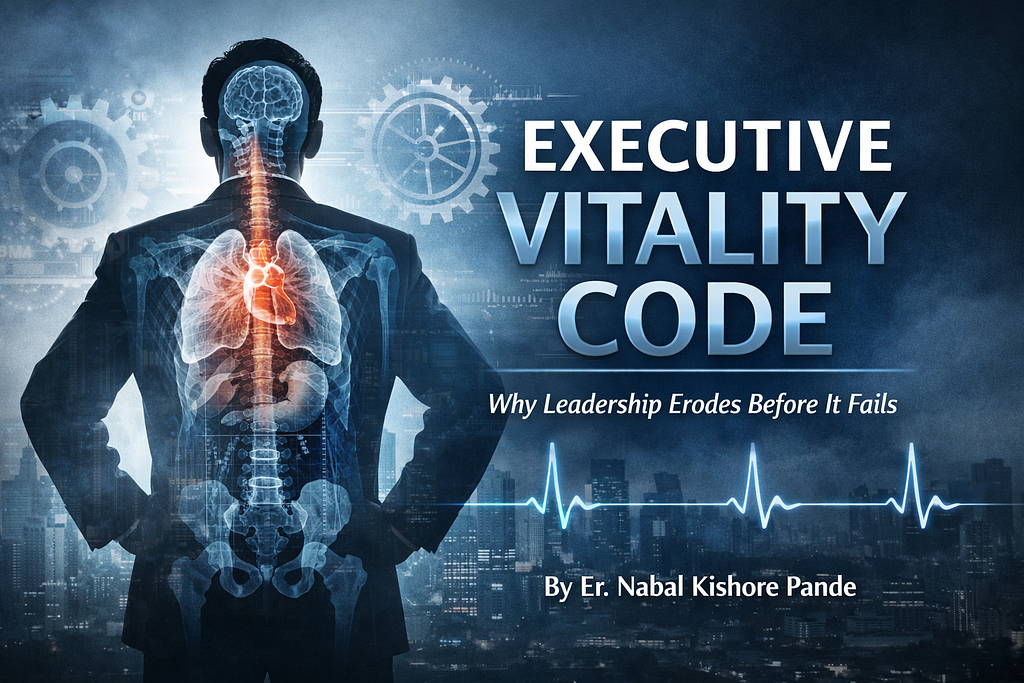
For individuals whose decisions affect companies, hospitals, public systems, or families, the body is not merely personal. It functions as executive infrastructure. When that infrastructure weakens, judgment shifts long before strategy collapses.
Leadership failure is usually described as an intellectual event.
Its origin is often physiological.
The Quiet Sequence Behind Poor Decisions
Leadership decline rarely begins with ignorance or incompetence.
It begins earlier, and more quietly, with changes that feel insignificant at first:
narrowing attentionunstable recoveryrigid postureshortened patiencedisturbed sleep rhythms
Only later does this appear as flawed reasoning, impulsive policy, or ethical fatigue. Organizations typically analyze the final stage while ignoring the biological sequence that preceded it.
This gap — between biology and governance — is where many careers quietly break.
Why Most Executive Health Advice Misses the Real Problem
The majority of material offered to leaders comes from lifestyle culture.
It emphasizes:
exercise routinesdiet plansmotivational coachingproductivity techniques
These approaches assume the leader is a private individual seeking personal improvement.
A senior decision-maker is not only a private individual.
He or she is a load-bearing structure within an institution.
What such roles require is not inspiration.
They require operational stability.
Vitality as a System, Not a Hobby
An engineer does not maintain a bridge through enthusiasm.
He studies fatigue, maintenance cycles, stress limits, and failure modes. Leadership deserves the same seriousness.
Executive vitality concerns:
How breathing patterns influence risk perceptionHow posture shapes emotional rangeHow recovery governs patience under pressureHow chronic tension narrows ethical judgment
These are not fitness trends or motivational claims.
They are structural realities of human performance under long time horizons.
The Intention Behind Executive Vitality Code
Executive Vitality Code: A Scientific Fitness System for Elite Leaders was written as a desk reference, not a motivational read.
It intentionally avoids:
workout programsdiet prescriptionsclinical treatmentinspirational language
Instead, it offers:
a governance framework for vitalityprecise language linking physiology to judgmentconceptual models designed for decades of responsibility
The purpose is straightforward:
to help leaders remain stable enough to think clearly when pressure becomes permanent.
Who This Perspective Is For
This framework serves:
founders whose decisions shape families and livelihoodsAdministrators responsible for public or institutional systemsprofessionals carrying irreversible outcomesadvisors supporting leaders under sustained pressure
For such roles, vitality is not a personal luxury.
It is organizational risk management.
Where Serious Leaders Begin
The first step is to reject the idea that health is separate from authority.
More useful questions are:
Does my physical condition widen or narrow my decisions?Is my recovery intentional or accidental?Am I governing my physiology — or merely enduring it?
Leadership is not only about strategy, but also about acting in the world.
It is biology acting on strategy.
About the Author
Er. Nabal Kishore Pande
Pithoragarh, India
ORCID: 0009–0007–3325–9966
WorldCat Author Record: Pande, Nabal Kishore
WIKI: Q137731110
Executive vitality will never appear on balance sheets.
Yet every balance sheet eventually reflects it.
Executive Vitality Is Not Wellness — It Is Infrastructure was originally published in Coinmonks on Medium, where people are continuing the conversation by highlighting and responding to this story.