
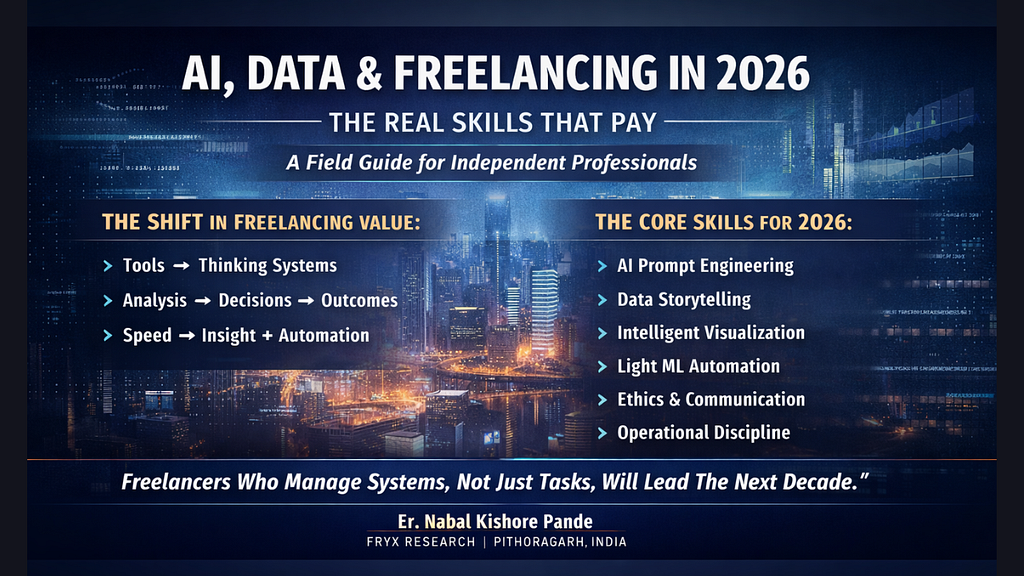
The freelance data profession is experiencing its most dramatic shift since cloud analytics became mainstream. For nearly a decade, value was measured by technical execution — how well someone could build dashboards, clean datasets, or run models.
In 2026, that definition has changed.
Clients no longer pay primarily for doing data work. They pay for decisions delivered with speed, clarity, and reliability. Artificial intelligence has compressed technical effort, but it has expanded the need for judgment, communication, and systems.
This article is a practical field guide for freelancers who want to remain relevant — and highly paid — in an AI-first market. It blends technical realities with operational discipline, because success today depends on both.
1. From Data Technician to Decision Partner
For years, the freelance data workflow looked predictable:
Receive datasetClean itAnalyzeVisualizeEmail results
AI has automated steps 2–4 to an astonishing degree. Tools such as GPT-4o, Claude, Gemini, Power BI Copilot, and Tableau GPT can now propose formulas, detect anomalies, and even narrate findings.
What remains uniquely human are:
framing the right questiontranslating numbers into business consequencesprotecting clients from bad assumptionsdesigning processes that repeat safely
The modern freelancer is not a spreadsheet operator; they are a decision architect.
2. Prompt Engineering: The New Core Literacy
Prompt engineering is often misunderstood as “asking AI nicely.” In practice, it is closer to software design — structured instructions that produce consistent, auditable outputs.
A strong prompt for a freelance project should contain:
business objectivedata contextcalculation rulestone and audienceoutput format
Example
“Using the attached quarterly dataset, calculate ROI by channel, highlight the top 3 risks, and produce a 150-word executive summary suitable for investors. Use cautious language for estimates.”
This single instruction can replace hours of manual writing.
Freelancers who maintain prompt libraries — versioned, tested, reusable — are already delivering reports at a fraction of the old time while charging strategic rates rather than hourly survival fees.
3. Data Storytelling: Where Real Value Lives
A dashboard answers what.
A story answers so what.
Executives rarely open CSV files. They open conversations. The freelancer who can convert analysis into narrative becomes indispensable.
Effective data storytelling includes:
clear cause-effect logicvisuals tied to decisionsacknowledgement of uncertaintynext actions, not just insights
AI accelerates the mechanics, but the freelancer provides judgment: which metric matters, which comparison is misleading, which recommendation fits the client’s reality.
This is why storytelling — not coding — is becoming the highest-paid layer of freelance analytics.
4. Visualization Is Becoming Conversational
The era of static charts is ending. Clients now expect dashboards that explain themselves.
Modern stacks allow:
auto-generated captions in Tableauanomaly explanations in Power BInatural language queries in Looker/Gemini
The freelancer’s job is shifting from “build a chart” to “design a visual conversation.” Layout, hierarchy, and cognitive load matter more than technical tricks.
5. Machine Learning Lite: Practical, Not Academic
Most clients do not need research-grade AI. They need:
churn predictionsentiment classificationdocument summarizationsimple forecasting
AutoML platforms and pre-trained models deliver this without deep coding. The competitive freelancer knows when to use lightweight ML and, more importantly, when not to.
Value lies in application fit, not algorithm prestige.
6. Automation: The Invisible Pay Raise
Income in freelancing grows through leverage. AI provides that leverage:
Weekly KPI emails are generated automaticallydata cleaning via AI regexalerts when thresholds breakreport drafts produced before meetings
The freelancer who builds pipelines earns while sleeping; the one who builds files sells time forever.
7. Ethics and Trust: The New Gatekeepers
As AI output increases, client anxiety rises:
Is this biased?Was sensitive data used?Can we explain the numbers?
Transparency is now part of deliverables. Ethical freelancers document:
where AI was usedlimitations of modelshuman review steps
Trust has become a technical requirement.
8. The Hidden Battlefield: Operations
Here is the uncomfortable truth: most freelancers don’t fail because of weak analytics. They fail because of weak systems.
Common profit killers:
late or confusing invoicesverbal agreementsscope creepchaotic onboardingpoor follow-ups
AI cannot rescue disorder. Only the process can.
9. Building the System-First Freelancer
Over years of working with global clients, I saw a pattern: talented people lost income not from lack of skill but from lack of structure.
That observation led me to design the FRYX MICRO series — small, focused playbooks ($21 each, 18–27 pages) that standardize freelance operations.
They cover practical realities such as:
professional invoicing flowscontract buildersscope-creep shieldsproposal converterspayment reminder sequencesSOP creationretainer designdispute handling
These are not theory books; they are working checklists and templates built from real projects.
10. Technical Excellence + Business Discipline
The freelancer of 2026 needs two engines:
Engine A — AI Data Skills
prompt engineeringstorytellingvisualizationML liteautomation
Engine B — Operations
contractsonboardinginvoicingcommunicationprocess documentation
Either engine alone is fragile. Together, they create a resilient career.
11. How to Position Yourself Today
Show outcomes, not tools
Clients care about revenue, risk, time — not model names.Publish narrative samples
One good story beats ten dashboards.Automate your own workflow first
Become the case study you sell.Document everything
Process is proof of professionalism.
12. A Practical Starting Path
Build 5 reusable promptsCreate one storytelling templateAutomate one recurring reportStandardize invoices and contractsCollect two testimonials
Small steps compound into authority.
13. Why This Matters
The market is splitting into two groups:
Freelancers replaced by AIFreelancers amplified by AI
The difference is not talent — it is system design.
Soft Invitation
If you want ready-to-use systems instead of reinventing them, the FRYX MICRO toolkit is available here:
👉 https://fryxresearch.gumroad.com/l/fryx-isfe00
Each guide is built to plug directly into real freelance work — no fluff, only repeatable actions.
Final Thoughts
AI did not end freelance data work.
It ended casual freelance data work.
The winners will be those who combine:
technical fluencynarrative intelligenceethical transparencyoperational discipline
That is the profile of the 2026 freelancer: part analyst, part storyteller, part systems engineer.
Strong mind. Strong words. No excuses.
Er. Nabal Kishore Pande
The 2026 Freelance Data Economy: AI, Trust, and the Rise of the System-First Freelancer was originally published in Coinmonks on Medium, where people are continuing the conversation by highlighting and responding to this story.