
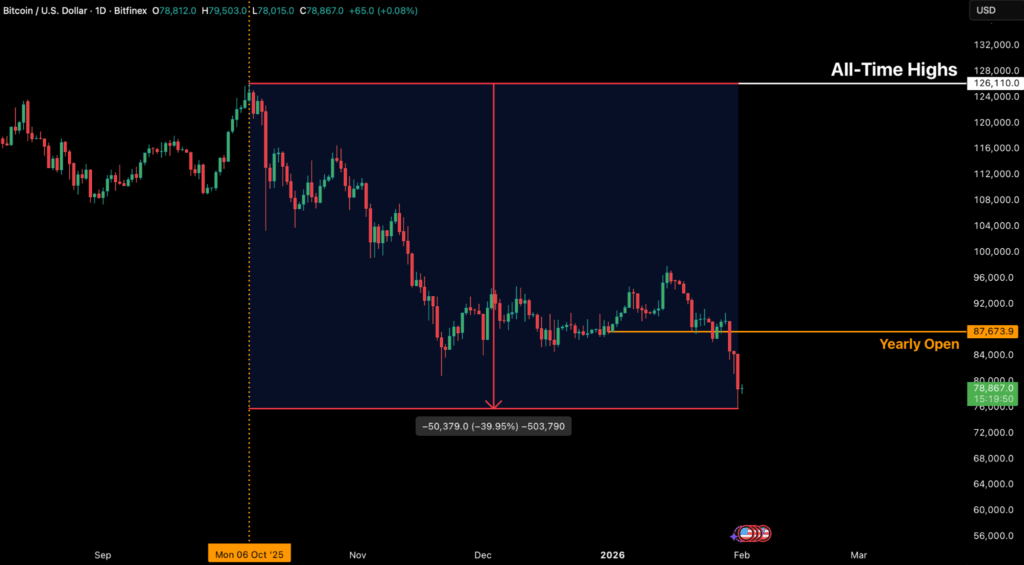
Bitcoin has led a renewed risk-off move across crypto, breaking decisively below $80,000 for the first time since April 2025 and marking the deepest drawdown of the current cycle at nearly 40 percent from the October peak. Thin weekend liquidity accelerated the sell-off, triggering a $2.5 billion liquidation wave dominated by long positions, while US spot Bitcoin ETFs recorded their largest weekly outflows since launch at roughly $1.5 billion. The loss of key on-chain and technical supports, including the True Market Mean, highlights the absence of marginal spot demand at a time when leverage was still elevated.
The drawdown has been driven less by internal crypto weakness and more by a sharp deterioration in the macro backdrop. Hawkish implications from the proposed Fed chair succession, renewed US fiscal uncertainty, and escalating geopolitical risks have pushed capital toward cash and Treasuries, amplifying downside volatility in digital assets. Altcoins suffered sharper dislocations, particularly Ethereum and Solana, though selective inflows into smaller-cap ETFs suggest tactical rotation rather than broad capitulation. With leverage now materially reduced and speculative excess flushed, the market appears to be undergoing a structural reset. Near-term direction will hinge on whether price can reclaim key realised cost levels and whether macro pressure eases enough to allow institutional demand to re-emerge.
The current macro and digital asset landscape reflects an economy that remains resilient but increasingly complex, with policymakers, investors, and institutions navigating persistent inflation risks, shifting confidence, and structural change.
The Federal Reserve’s decision to hold rates steady at 3.5–3.75 percent underscores its view that US growth remains strong enough to warrant caution on cutting further, as inflation, particularly in services, continues to run above target, especially as productivity gains, while encouraging, have yet to prove durable.
Recent data reinforces this stance: producer prices surprised to the upside, driven by services rather than goods; manufacturing surveys point to stabilisation rather than a full expansion, and rising inventories suggest growth is steady but not accelerating, leaving the Fed comfortable remaining patient unless labour market conditions weaken meaningfully. At the same time, financial markets are sending continued signals that it is re-setting risk, as a sharply weaker US dollar and a sustained rally in gold reflect growing concerns over fiscal discipline, policy predictability, and long-term purchasing power (even as gold’s recent pullback appears more consistent with profit-taking than a reversal of the broader trend). These dynamics add pressure to policymakers, as a softer dollar complicates inflation control while rising gold prices hint at declining confidence in fiat systems.
Against this macro backdrop, structural shifts in digital finance are accelerating: Tether’s record profits and massive US Treasury exposure highlight surging global demand for dollar liquidity outside traditional banking rails. Meanwhile, Japan’s move toward approving crypto ETFs by 2028 signals deeper institutional acceptance of digital assets within regulated markets.
The post Bitfinex Alpha | Crypto Undergoes Structural Reset appeared first on Bitfinex blog.