
A Market Defined by Contest, Not Collapse
Bitcoin’s current market behavior has confused even experienced participants. Price swings are sharp. Volatility appears suddenly. Headlines change tone daily. And yet, despite all of this motion, the market struggles to sustain a clean directional trend.
To some observers, this looks like weakness.
To others, it looks like manipulation.
To a smaller and more accurate group, it signals something far more consequential.
This distinction matters. Markets break when demand disappears, liquidity evaporates, or confidence collapses across participant classes. None of those conditions defines the current environment. Instead, Bitcoin is navigating a rare and complex redistribution phase, where large amounts of supply are changing hands between holders with fundamentally different incentives, time horizons, and risk tolerances.
This is not a trader-dominated market. It is a market governed by competing mandates.
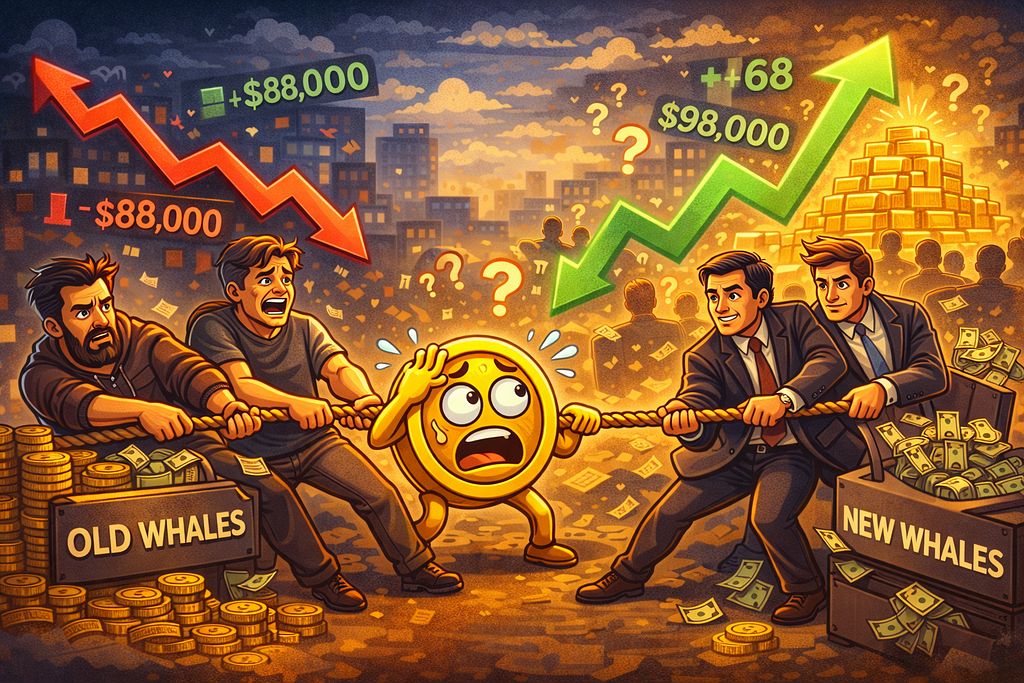
At the center of this phase is a tug of war between different categories of Bitcoin whales. Some are deeply profitable long-term holders who accumulated years ago. Others are relatively new entrants, often institutional in nature, whose cost bases sit close to current prices. Their interaction, not news headlines or short-term indicators, is shaping Bitcoin’s price behavior.
Understanding this tug of war is essential for interpreting Bitcoin’s present without falling into narrative traps.
The Quiet Shift From Early Whales to Institutional Giants
For most of Bitcoin’s history, large holders shared a defining characteristic. They were early.
Early whales accumulated Bitcoin at prices that now feel almost fictional. Many mined or purchased BTC when it traded for tens, hundreds, or low thousands of dollars. Their cost bases granted them extraordinary psychological flexibility. Price volatility, even severe drawdowns, did not threaten their thesis or their solvency.
That era no longer defines Bitcoin’s marginal buyer.
Today, the dominant source of new demand comes from institutional entities. Corporate treasuries, regulated investment vehicles, exchange-traded products, and structured allocators now absorb a growing share of circulating supply. Their decision-making processes differ fundamentally from those of early adopters.
Institutional buyers operate under formal mandates. Capital deployment is governed by committees, risk frameworks, reporting requirements, and fiduciary obligations. These constraints shape behavior in ways that are less emotional but more complex.
Companies like MicroStrategy exemplify this transition. Their approach is explicit and unapologetically long-term. Accumulation is not a trade. It is a balance-sheet strategy. Newer entrants have gone further, openly stating that acquiring Bitcoin at scale is the primary objective, not a side allocation.
The importance of this shift cannot be overstated. Institutional capital does not behave like retail capital. It does not react reflexively to short-term price movements. It operates on conviction, policy alignment, and multi-year horizons.
As this cohort grows, Bitcoin’s market structure evolves with it.
Why New Whales Matter More Than Old Whales Right Now
Whales have always influenced Bitcoin. What has changed is which whales matter most at this stage of the cycle.
On-chain data shows that large holders with shorter holding periods now control more supply than long-term holders in the same size bracket. This represents a structural inflection point. Power over marginal price action has shifted toward participants whose exposure is newer and whose cost bases are higher.
These “new whales” differ from the old guard in several critical ways.
First, cost basis proximity.
Many institutional positions were built during periods of elevated prices. Their average entry levels sit closer to current market values, which creates sensitivity. Price fluctuations matter more when unrealized losses or gains sit within reporting thresholds.
Second, accountability.
Institutional holders answer to boards, shareholders, regulators, and investors. Even when conviction remains intact, drawdowns trigger internal review. Risk is not only financial. It is reputational.
Third, heterogeneity.
New whales are not uniform. Some are long-only strategic accumulators. Others are flexible allocators who reassess exposure based on macro conditions, liquidity, or portfolio correlations.
This diversity within the cohort creates internal tension. Some absorb supply aggressively during dips. Others reduce exposure when uncertainty rises. The result is a constant exchange of supply rather than a one-sided flow.
That is the tug of war.
The market is not witnessing mass distribution or unified accumulation. It is experiencing selective selling met by selective buying, often at the same price levels.
The $6 Billion Question: Why Unrealized Losses Matter
Unrealized losses do not directly move markets. Behavior does.
When a large cohort of holders collectively sits on billions in unrealized losses, markets enter a phase of psychological stress testing. Every rally becomes a decision point. Every dip becomes a referendum on conviction.
For some new whales, lower prices represent opportunity. They view volatility as noise within a longer-term thesis. For others, the same price action introduces risk considerations related to capital allocation, portfolio balance, or governance oversight.
This asymmetry creates friction.
Sellers emerge not because belief collapses, but because tolerance differs. Buyers step in not because assets are cheap in absolute terms, but because supply becomes available.
This is why Bitcoin can move violently without establishing trend continuity. Supply rotates rather than exits the system.
Importantly, this behavior diverges sharply from bear market dynamics. In bear markets, demand retreats and liquidity thins. Here, demand remains present. What fluctuates is the willingness to absorb at specific price levels.
This process is slow, uneven, and frustrating. It is also constructive.
Why This Is Not a Bear Market Signal
It is tempting to interpret range-bound volatility as weakness. That interpretation misreads the underlying mechanics.
True bear markets share three characteristics:
Sustained demand destruction
Forced selling across multiple cohorts
Persistent liquidity withdrawal
None of these dominates the current environment.
Demand remains active, particularly among long-term allocators. Liquidity, while volatile, remains accessible. Forced selling exists, but it is localized rather than systemic.
What we are witnessing is redistribution, not abandonment.
Markets often confuse discomfort with danger. This phase is uncomfortable because it resists simple narratives. It does not reward trend chasing or blind conviction. It rewards patience and structural understanding.
Macro Noise vs Structural Reality
Macroeconomic and geopolitical developments continue to influence Bitcoin’s short-term price movements. Tariff threats, rate expectations, and policy signaling inject volatility into all risk assets.
But volatility is not structure.
Macro events explain why price moves on a given day. Whale dynamics explain why the price struggles to trend over weeks and months.
When strategic buyers absorb dips while pressured sellers distribute into strength, the price oscillates. News becomes a catalyst rather than a driver.
This distinction prevents overreaction. It keeps focus on the deeper forces shaping the market rather than the surface-level triggers.
Why Volatility Spikes Without Follow-Through
Bitcoin’s recent price behavior follows a recurring pattern. Sharp declines trigger liquidations. Prices rebound quickly. Momentum fades. The market stalls.
This pattern reflects leverage reset rather than value discovery.
Liquidations remove excess positioning. Absorption stabilizes price. The absence of new marginal demand caps upside. The cycle repeats.
Each iteration transfers coins from weaker conviction to stronger hands. Over time, this reduces fragility. But the process is nonlinear and uneven.
Volatility without follow-through is not failure. It is digestion.
What Search Behavior Confirms About Market Psychology
Search data offers a revealing lens into investor psychology.
Interest has shifted away from speculative targets toward explanatory queries. Participants are asking why Bitcoin behaves this way, who is selling, and whether whales control the market.
This indicates a transition from belief-driven engagement to interpretation-driven engagement.
Historically, such phases precede resolution. Not immediately, but eventually. Markets pause to reassess before committing to the next directional move.
Scenario Analysis: How the Tug of War Resolves
Scenario One: Absorption Completes
In this scenario, pressured sellers finish distributing. Strategic buyers consolidate supply. Volatility compresses. Price stabilizes before regaining directional bias.
This outcome favors patience.
Scenario Two: Stress Forces Further Distribution
If price revisits lower levels, some new whales reduce exposure. Stronger hands absorb at scale. Ownership concentrates further.
This outcome favors discipline.
Scenario Three: Macro Shock Overrides Structure
A major policy or liquidity shock overwhelms internal dynamics. Correlations spike. Structure reasserts itself after the shock passes.
This outcome favors resilience.
None of these scenarios implies collapse.
What This Means for Investors, Not Traders
This market does not reward speed. It rewards understanding.
Investors should focus on:
Cost-basis distribution
Liquidity sensitivity
Time-horizon alignment
Exposure sizing
This is not a moment to chase narratives. It is a moment to respect structure.
The Bottom Line: Bitcoin Is Scarce Because It Is Contested
Bitcoin’s current market is not directionless. It is deliberate.
It reflects a tug of war between old conviction and new capital, between strategic accumulation and tactical pressure, between time horizons that do not align.
The market is deciding who owns the next cycle’s supply.
That decision will not be made by headlines or predictions.
It will be made through absorption.
And that process is already underway.
FAQs
1. Why is Bitcoin so volatile right now?
Bitcoin is volatile because large holders with different time horizons are actively exchanging supply. This creates sharp moves without sustained trends. Volatility reflects redistribution, not collapse.
2. Are whales manipulating Bitcoin’s price?
Whales influence price through size, not coordination. The current behavior reflects conflicting incentives rather than deliberate manipulation.
3. Why do rallies fail to continue?
Rallies attract selective distribution from holders managing risk, while absorption prevents collapse. This creates range-bound behavior.
4. Is this a sign of a bear market?
No. Demand remains active and liquidity intact. This phase reflects ownership transfer rather than demand destruction.
5. Why do institutional buyers matter so much now?
Institutions control large capital pools and operate with long-term mandates, altering how supply reacts to price movements.
6. What role do unrealized losses play?
Unrealized losses influence behavior by testing conviction and risk tolerance, especially for accountable institutions.
7. Why doesn’t macro news create lasting trends?
Macro events act as catalysts, but structural supply dynamics determine whether trends persist.
8. Is Bitcoin still scarce if the price is stagnant?
Yes. Scarcity is reflected in contested ownership, not constant price appreciation.
9. What should long-term investors focus on?
Structure, liquidity, cost-basis distribution, and time horizon alignment.
10. How does this phase typically resolve?
Through absorption and consolidation, followed by renewed directional movement once supply stabilizes.
Bitcoin Whales in a Tug of War: What Is Happening in the Crypto Market? was originally published in Coinmonks on Medium, where people are continuing the conversation by highlighting and responding to this story.