
And how a more advanced approach changed the way I trade momentum, breakouts, and liquidity
Volume is one of the most widely used metrics in trading. Every crypto trader, from beginner to professional, has stared at the green and red bars under their chart trying to decode market intent.
But here’s the uncomfortable truth:
Most traders are reading the wrong volume.
Or worse — they’re reading it in the wrong context.
This is especially true when it comes to the popular Daily 24h Volume indicator. You’ve probably seen it on exchanges like Binance, Bybit, OKX — and on TradingView indicators that attempt to emulate it.
And while the metric sounds intuitive (“how much volume traded in the last 24h”), it’s often misunderstood and misapplied in live trading.
In this article, I want to break down:
Why many traders rely on Daily 24h Volume IndicatorWhat its conceptual weaknesses areHow it differs from standard bar-by-bar volumeA clear comparison between the twoAnd how these insights led me to build a customized, more actionable volume engine that I personally use
Let’s start with the basics.
1. Why Traders Use Daily 24h Volume Indicator
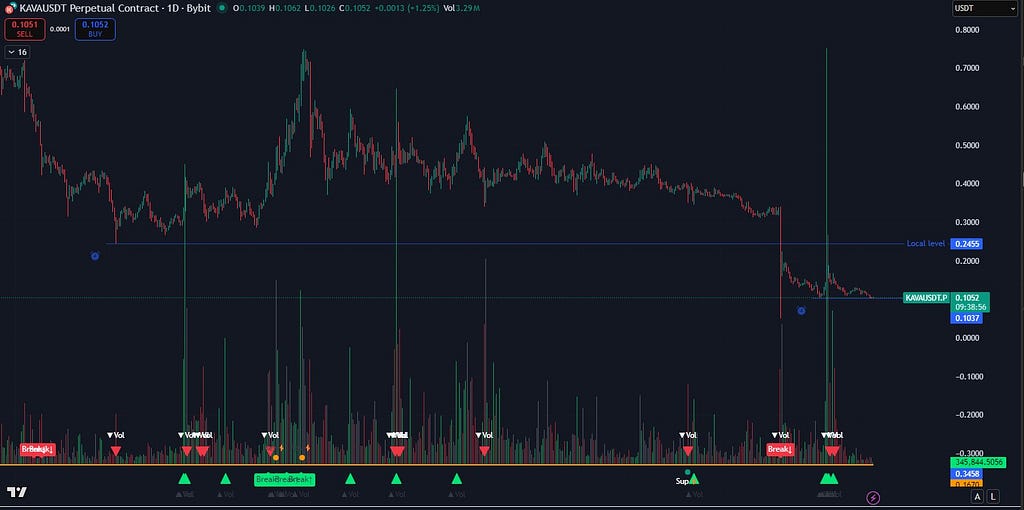
At the bottom, the 24-hour volume is highlighted in red, compared to the standard volume indicator above.
Daily 24h Volume Indicator is attractive because:
It reflects overall market participationIt updates continuously and shows exchange-wide liquidityIt gives a sense of the asset’s current “activity level”
For example:
If 24h volume is rising → traders assume interest is growingIf 24h volume is dropping → traders assume liquidity is drying up
It’s a macro-level liquidity gauge.
But here’s the problem:
Daily 24h volume does NOT tell you what’s happening right now on your candle. It tells you what happened in the past day, smoothed into one enormous rolling window. This introduces several pitfalls.
2. The Weaknesses of Daily 24h Volume (Why It Misleads Traders)
Weakness 1 — It’s a rolling metric, not a per-bar signal
Daily 24 volume cannot show momentum shifts inside a candle. You might think volume is increasing… But it’s actually just updating the rolling window.
Weakness 2 — It hides individual bar structure
It blends all buy/sell pressure, spikes, and micro-movements into one big number.
You miss:
Who is in control (buyers or sellers)Strength of candle bodyWick dominanceVolume spikes on breakouts
Weakness 3 — It reacts slowly
Because it covers the full 24h window, it behaves like a moving average:
Big events fade slowlySudden surges barely move the lineIt lags on market turns
Weakness 4 — Traders assume it reflects “current volume”
But the bar forming RIGHT NOW could have:
Huge actual volumeBut Daily 24 barely moves
— or —
Very small actual volumeBut Daily 24 stays high from past candles
This disconnect confuses decision-making.
3. Standard Volume vs Daily 24 Volume — Conceptual Differences
Below is a simplified comparison to set things straight.
In short:
Daily 24h volume is liquidity context.Per-bar volume is actionable information.
Most traders mix these two concepts — and get confused signals as a result.
4. Why I Built My Own Volume Indicator
After years of active crypto trading, I realized I needed:
Something as reliable as per-candle volumeSomething as informative as exchange 24h volumeSomething that actually helps predict breakouts and momentum shiftsSomething that reflects real buying/selling pressure, not just bar colorSomething that filters noise and highlights meaningful spikes
This led me to develop the Advanced Volume Suite — a tool that merges the strengths of both worlds:
Exchange-style liquidityReal-time actionable volume signalsMomentum detectionSpike identificationBreakout confirmation
It’s the volume engine I personally use in my trading, and now I’m sharing it publicly.
The next section describes how it works.
5. Introducing a complete professional toolkit for reading true market volume, momentum, and liquidity: Advanced Volume Suite (24h, Pulse, Spikes, Breakout Pressure)
🔍 What This Indicator Does
The Advanced Volume Suite is a multi-layered volume analysis system designed for traders who rely on volume as a primary decision driver. It expands far beyond TradingView’s standard volume bars by adding:
✔ True USDT Volume
All volume is converted into USDT value (volume × close) to normalize activity across increasing or decreasing prices.
✔ Rolling 24-Hour Volume (Exchange-style metric)
The indicator calculates a custom 24h rolling volume, just like Binance and Bybit display.
✔ Volume Pulse (Strength vs Average)
A powerful ratio that measures momentum inside each bar.
✔ Smart Volume Spike Detection
Identifies abnormal activity using:
Body strengthWick compressionTrend alignment
✔ Breakout Pressure Engine
Detects:
Confirmed breakoutsFakeoutsAreas where pressure is building near key levels
6. Fully customizable Advanced Volume Coloring — 3 modes
The indicator introduces intelligent volume bar coloring, which improves clarity and helps interpret orderflow visually:
1️⃣ Simple Mode
Green = close > open
Red = close < open
(Like standard volume but using USDT values)
2️⃣ Body Mode
Colors only when candle body is strong relative to its range.
Filters noise and highlights meaningful bars.
3️⃣ Delta-Style Mode
Detects “aggressive” buyers or sellers based on:
Candle body dominanceUpper/lower wick compressionDirectional pressure
7. Why This Matters to Traders
This indicator bridges the gap between:
Micro-level volume (per-candle activity)Macro-level liquidity (24h rolling volume)
And wraps it into:
A visual breakout systemA momentum pulseSmart spike detectionReal candle-based volume coloring
It replaces multiple tools and simplifies your volume-based decision-making.
8. How It Differs From the Standard Volume Indicator
9. Final Thoughts
Volume is one of the most important trading metrics — but only when interpreted correctly.
Standard volume shows real-time behaviorDaily 24h volume shows high-level liquidityMy custom indicator merges both concepts and adds intelligent layers for clarity
If you’ve ever missed a breakout, failed to see a spike, or misjudged the strength behind a move, this suite gives you the clarity you were missing.
This indicator is fully free and open-source on TradingView, so that traders can review and verity its functionality.
Advanced Volume Suite (24h, Pulse, Spikes, Breakout Pressure) — Indicator by zalutskyiyuriy — TradingView
Why Most Traders Misread Volume: A Deep Dive into Standard Volume vs Daily 24h Volume was originally published in Coinmonks on Medium, where people are continuing the conversation by highlighting and responding to this story.