
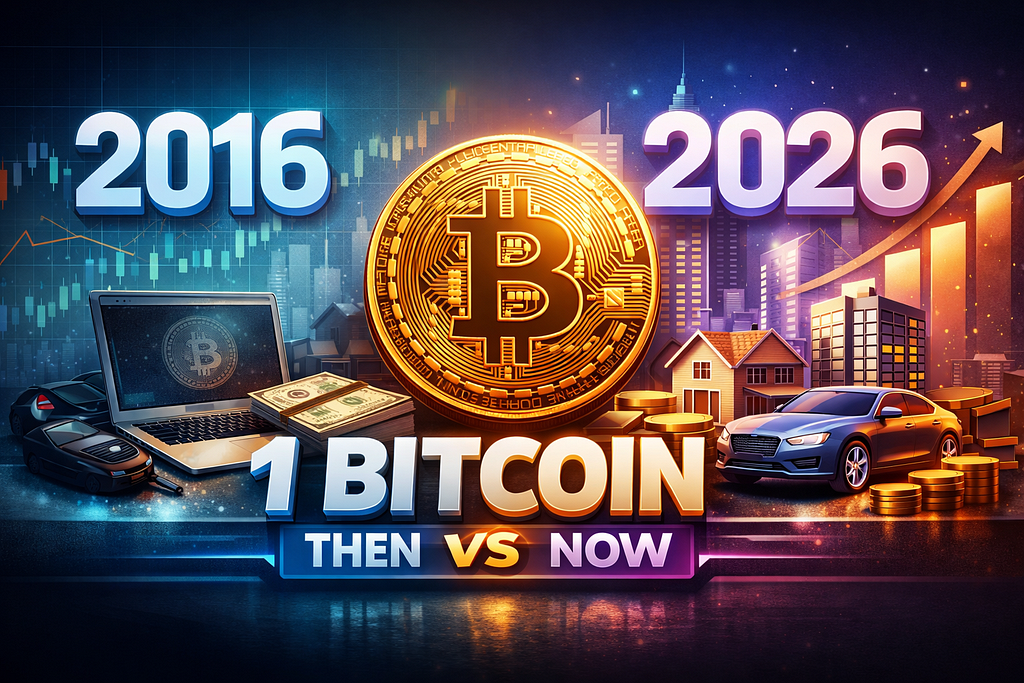
2016 vs 2026: What You Could Buy With 1 Bitcoin Then — and What It Means Now
A personal look at how Bitcoin changed — not just in price, but in purpose.
Over the past few months, I’ve been actively learning about cryptocurrency.
Not as a trader chasing fast profits, but as someone trying to understand what Bitcoin actually became over time.
At some point, I stopped looking at charts and asked a simpler question — one that feels much more human:
What could you realistically buy with 1 Bitcoin in 2016,
and what can you buy with it in 2026?
Bitcoin in 2016: A Few Hundred Dollars
In 2016, Bitcoin traded mostly between $400 and $900 per BTC.
Let’s take a rough average: around $600.
Back then, 1 Bitcoin could buy:
a used cara solid laptop and a smartphone3–6 months of renta regular vacationbasic furniture or home appliances
Bitcoin felt like spendable money.
Strange, experimental, volatile — but still something you could exchange for everyday things without much hesitation.
1 BTC ≈ a few hundred dollars.
A Decade of Change
Between 2016 and 2026, the world changed dramatically:
repeated financial crisesrising inflationdeclining trust in traditional institutionsmoney becoming fully digital
Bitcoin didn’t just survive this decade — it evolved alongside it.
It went through multiple market cycles, endless skepticism, and countless predictions of its death. And yet, it kept coming back.
Bitcoin in 2026: A Different Order of Magnitude
By 2026, Bitcoin exists on a completely different scale.
Today, 1 BTC is worth tens of thousands of dollars — roughly in the range of
$40,000–$80,000+, depending on market conditions.
That’s not a marginal increase.
That’s a fundamental shift.
1 BTC in 2026 is no longer “money for purchases.”
It’s capital.
What You Can Actually Buy With 1 Bitcoin in 2026
When translated into real life, 1 Bitcoin in 2026 can realistically represent:
a new mid-range or business-class cara down payment on real estatea full year of living in another countryseed capital for a small businessa diversified investment portfolioeducation, relocation, or other major life expenses
These aren’t impulse buys anymore.
They’re life-level decisions.
The Most Important Shift: People Stopped Spending Bitcoin
This is where the real difference between 2016 and 2026 shows up.
In 2016, Bitcoin was mostly:
spentexchangedtreated like a payment method
In 2026, Bitcoin is mostly:
heldused as collateralborrowed againstviewed as a long-term store of value
Technically, you can spend Bitcoin.
Practically, most people choose not to.
Why the Price Isn’t the Whole Story
Yes, Bitcoin became dramatically more expensive over ten years.
In some periods, its value increased by dozens — even hundreds — of times.
But the more important change is functional.
In 2016, the main question was:
“What can I buy with Bitcoin?”
In 2026, the question sounds different:
“How does Bitcoin fit into my financial life?”
That’s a shift from consumption to strategy.
A Personal Takeaway
Looking at Bitcoin through the lens of 2016 and 2026 made one thing clear to me:
Bitcoin isn’t just an asset that went up in price.
It’s an asset that changed how people think about money.
About control.
About optionality.
About the future.
And maybe that’s why the question
“What can you buy with 1 Bitcoin?”
gradually became less important than another one:
What does it mean to own one?
Final Thoughts
2016: 1 BTC ≈ $400–900 → everyday purchases2026: 1 BTC ≈ tens of thousands of dollars → capital and optionality
Over ten years, Bitcoin didn’t just change in price.
It changed its role — and, in many ways, changed us too.
2016 vs 2026: What You Could Buy With 1 Bitcoin Then — and What It Means Now was originally published in Coinmonks on Medium, where people are continuing the conversation by highlighting and responding to this story.