
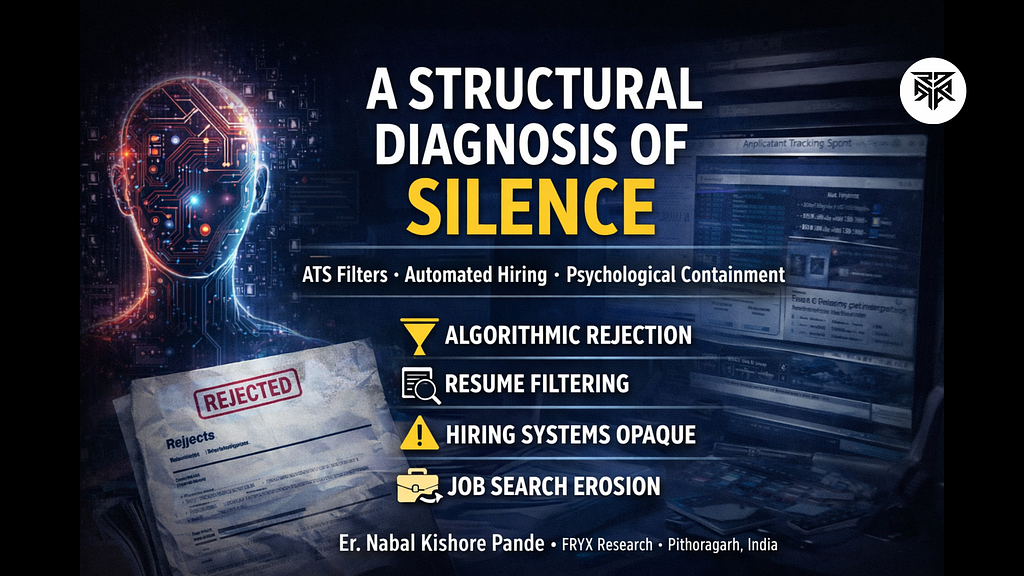
Visual representation of automated hiring systems, ATS filtering, and the structural silence experienced by job applicants.
In the last decade, job search has quietly changed shape. Not in visible ways like resumes becoming digital or interviews moving online, but in something more subtle: silence has become the default response.
Applications disappear. Portals show “under review” for months. Follow-ups receive no reply. Rejections, when they arrive, are generic and delayed. For many Gen Z and mid-level professionals, this silence is no longer an exception. It is the normal experience.
A Structural Diagnosis of Silence approaches this reality without advice, motivation, or corrective strategies. It treats silence not as a personal problem, but as a system outcome.
Silence Is Not Feedback
Most applicants assume silence means evaluation is still happening. The book challenges this assumption early and directly.
Modern hiring systems are designed to operate as filters, not conversations. Applicant Tracking Systems (ATS) ingest data, scan for predefined tokens, and discard anything that does not align with known patterns. No signal match means no progression. No progression means no response.
Silence, in this context, is not delayed judgment. It is the end state of a process that was never activated.
Understanding this distinction matters because it prevents misinterpretation. When candidates read silence as personal failure, they often respond by increasing effort — rewriting resumes, collecting certificates, applying more aggressively. The book explains why this often changes nothing.
Automation Is About Risk, Not Talent
One of the central arguments in the artifact is that automation in hiring exists primarily to reduce organisational risk, not to discover ability.
Hiring at scale introduces uncertainty. Human judgment is slow, inconsistent, and difficult to defend internally. Automated filters provide something safer: repeatability. They replicate past hiring patterns using compressed proxies like job titles, keywords, company names, and duration thresholds.
This means originality, non-linear careers, international experience, and unconventional paths often become invisible — not because they lack value, but because they lack encoding.
The system does not ask, “What might this mean?” It asks, “Have we seen this before?”
The Loss of Human Judgment at Scale
A recurring belief among applicants is that “someone must have seen my resume.” The book dismantles this gently but firmly.
At high volume, most applications never reach human eyes. Recruiters act as confirmation points for machine output, not evaluators of raw profiles. Their role is constrained by filters, score thresholds, and workflow capacity.
This explains why follow-ups often go unanswered. There is no active decision-maker to reply. The file is inert.
By naming this, the artifact removes a common source of psychological damage: the assumption that silence reflects hidden negative judgment.
Psychological Containment, Not Reassurance
Importantly, A Structural Diagnosis of Silence does not attempt to comfort the reader. It does something quieter.
It creates psychological containment.
Containment here means providing a stable explanatory frame that prevents the reader from internalising systemic outcomes as personal defects. The book does not promise success, clarity of the future, or improved results. It offers orientation.
For readers who have experienced months or years of non-response, this distinction matters. Clarity without optimism can still be stabilising.
Why This Is Not a Career Guide
The artifact explicitly rejects the categories it is often mistaken for. It is not a guide, not a strategy manual, not a workaround catalogue.
There are no templates. No hacks. No “do this instead.”
This refusal is deliberate. The book argues that adding tactics without addressing misinterpretation simply deepens confusion. Explanation comes first. Action, if any, is the reader’s responsibility.
This makes the work unusual in a landscape dominated by motivational language and success narratives. It is closer to a system note than a self-help text.
Who This Explanation Serves
The book is written for readers who already know how to apply, already meet qualifications, and already suspect that something structural is happening — but lack language for it.
Gen Z professionals are encountering automated hiring for the first time. Mid-career candidates are facing repeated stalls. International applicants navigating opaque filters. Anyone whose confidence is being eroded by non-feedback rather than failure.
For such readers, naming the system correctly can be more useful than being told to try harder.
Silence, the book argues, is not a message waiting to be decoded. It is a design feature.
Understanding that does not solve the market. But it can stop the market from damaging the person.
https://gum.new/gum/cmkdv6a4g000204l465g35ywc
A Structural Diagnosis of Silence: Why So Many Qualified Candidates Hear Nothing Back was originally published in Coinmonks on Medium, where people are continuing the conversation by highlighting and responding to this story.