
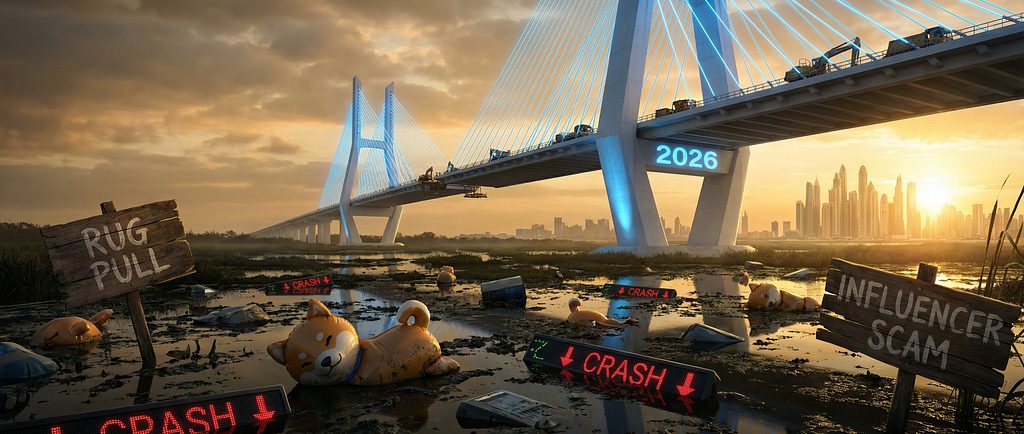
Will 2026 be the year of real crypto adoption?
Everyone’s been asking this for as long as I can remember. The answer was always no.
Until now.
Let’s be clear about where we are right now. We don’t have real adoption yet. Not even close. What we have is inflated metrics, speculation theater, and institutional accumulation masquerading as progress.
Before we talk about what’s possible, let’s define what ISN’T real adoption:
❌ Ownership in an ETF is not adoption. You don’t own the keys. You don’t interact with the chain. That’s TradFi wearing a crypto mask. BlackRock and Fidelity holding Bitcoin for you is the exact opposite of what this technology was built for.
❌ Celebrity memecoins wrecking thousands is not adoption. That’s exploitation that burns the bridges we need to build. Every rug pull, every worthless token that crashes 99%, every influencer scam creates another person who will never trust this space again.
❌ Saylor and BlackRock amassing 8% of BTC is not adoption. It’s institutional accumulation. Concentration of power in different hands, but concentration nonetheless. We’re just trading one set of gatekeepers for another.
❌ Inflated daily active user metrics is not adoption. Bot activity and airdrop farmers gaming systems for tokens isn’t usage. It’s theater. Wash trading dressed up as engagement. We’ve gotten really good at lying to ourselves with numbers that don’t mean anything.
So if that’s not adoption, what IS?
Real adoption means people using crypto because it solves a problem better than alternatives, not because they’re speculating on price or farming airdrops. And for the first time in years, we may actually see that happen.
Something is changing.
Walmart is now accepting Ethereum payments at checkout. Not through some convoluted third-party conversion. Direct crypto payments. Major retailers are following. Payment processors are integrating crypto rails because settlement is faster and cheaper than traditional card networks.
This isn’t hype. This is infrastructure being built in silence while everyone’s distracted by memecoin roulette.
Stablecoins are processing more transaction volume than Visa in certain corridors. Cross-border payments are happening in seconds instead of days. Remittances that used to cost 10–15% in fees now cost fractions of a percent.
Real use cases are emerging:
Freelancers in emerging markets getting paid directly without losing chunks to currency conversion and wire feesCreators experimenting with direct monetization without platform middlemen taking 30–50% cutsRefugees carrying their wealth across borders in wallets on their phones instead of losing everything
These aren’t theoretical anymore. They’re happening. Just not at scale yet.
But here’s what HAS to happen for 2026 to be different.
We need to solve the security crisis. Billion-dollar hacks are still happening. Users are still losing everything to signature scams and exploits. EVM chains are still bleeding funds because the token model is fundamentally broken.
Until we normalize onchain 2FA, social recovery, and native asset models that don’t require unlimited approval signatures, mainstream users won’t feel safe. And they shouldn’t. Security isn’t a feature. It’s the foundation. And right now, that foundation is cracked.
We need to fix the UX barrier. Seed phrases. Gas estimation. Network selection. Bridge protocols. For someone coming from Venmo or PayPal, Web3 feels like stepping back in time, not forward.
Account abstraction is maturing. Embedded wallets are removing seed phrases from the equation. Gasless transactions are viable on certain chains. Social recovery is deployable. The “my grandma could use this” test is getting closer. But we’re not there yet.
We need better storytelling. Not about number go up. About freedom, sovereignty, and solving REAL problems. Most people don’t know why decentralization matters because nobody’s explained it in terms that connect to their actual lives.
Banks freezing accounts over political views. Platforms debanking creators arbitrarily. Payment processors deciding who can and can’t do business. Financial surveillance expanding under the guise of safety. The “why crypto” narrative is finally becoming visceral for normies, not just cypherpunks. We just need to articulate it better.
So why am I optimistic about 2026?
Three things are converging that never aligned before. Real businesses are adopting crypto rails for practical reasons, not speculation. Trust in traditional institutions is eroding faster than I’ve ever seen. And the technology is finally approaching the usability threshold where friction becomes acceptable.
Adoption doesn’t happen gradually. It happens suddenly after years of invisible infrastructure building.
The internet existed for decades before it exploded in the 90s. Smartphones existed before the iPhone made them ubiquitous. Electric vehicles existed for a century before Tesla made them desirable.
Crypto has been building infrastructure for 15 years. The rails are laid. The technology works. The use cases are proven. What’s missing is the tipping point. And I think we’re closer to that moment than most people realize.
The question isn’t IF real adoption happens. It’s WHEN.
The potential of Web3 is far bigger than most probably even realize.
Financial systems that don’t require permission.Digital ownership without intermediaries.Identity that you control, not corporations.Transparent systems that can’t be manipulated by centralized authorities.
That future is inevitable. Not because we want it. Because the alternative is unsustainable.
Centralized systems are failing under their own weight. Trust is breaking. Control is tightening. People are looking for alternatives. And when they look, crypto needs to be ready.
Will 2026 be the year? Maybe. Maybe not.
But the conditions are aligning in ways they never have before. Businesses are adopting because it makes financial sense. Users are coming because they have real problems to solve. Infrastructure is maturing because builders are focused on utility over hype.
The signals are different this time. And for the first time in years, I’m genuinely hopeful.
Not because of price. Not because of institutional accumulation. Not because of hype cycles. But because real problems are finally meeting real solutions.
The technology is ready. The infrastructure is in place. The awareness is growing.
Now we just need to build something worth using. And I think 2026 might be the year we finally do.
Why 2026 Might Finally Break the Adoption Curse was originally published in Coinmonks on Medium, where people are continuing the conversation by highlighting and responding to this story.