
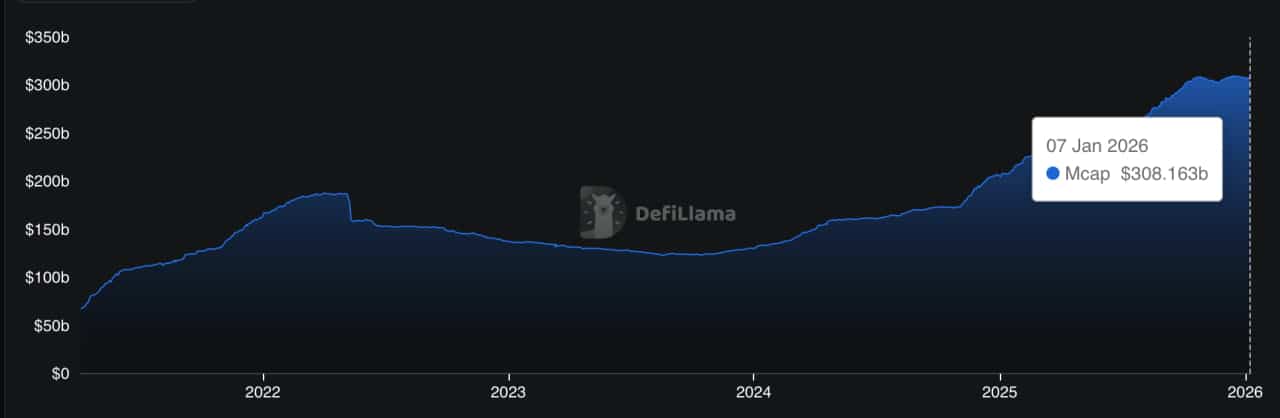
US lawmakers are debating last‑minute changes to the GENIUS Act after banking groups urged Congress to block third‑party rewards on stablecoins. The push landed as stablecoin supply passed $316 billion, a sign that everyday users already rely on dollar‑pegged tokens for payments and savings. The fight taps into a bigger theme: who controls digital dollars as crypto moves closer to the financial mainstream.
Stablecoins like USDC and USDT held steady at $1, but the policy noise hit crypto stocks and DeFi tokens tied to on‑chain yield. Traders read the debate as a warning that Washington still holds the steering wheel. Regulation, not price charts, set the tone.
The GENIUS Act already became law in June 2025, giving the US its first federal rulebook for stablecoins. Now banks want tighter language. That shift reopened fears that everyday users lose out while large institutions keep their edge.
JUST IN: Stablecoin volume hit $33 TRILLION in 2025 as the GENIUS Act accelerated adoption pic.twitter.com/jIYXmIdsnE
— Radar 𝘸 Archie (@RadarHits) January 8, 2026
DISCOVER: Top Ethereum Meme Coins to Buy in 2026
What Is the GENIUS Act, in Plain English?
The GENIUS Act sets ground rules for stablecoins. Think of a stablecoin as a digital dollar that lives on a blockchain, similar to cash in a checking app but without a bank in the middle. The law says issuers must hold real dollar reserves and follow strict oversight.
The act bans issuers from paying interest directly. Crypto platforms still reward users by sharing trading fees or lending returns. Banks now want Congress to close that path too.
Why does this matter to you? Because stablecoin rewards often beat bank savings accounts that pay close to zero. For beginners, this is one of the safest on‑ramps into crypto yield.
Why Are Crypto Executives Calling This a Big Deal?
Industry groups say banks fear competition, not risk. Lawmakers designed the bill to balance safety with innovation.
John Deaton, a pro‑crypto lawyer, warned that banning rewards pushes users toward China’s digital yuan, which already pays interest. He called the idea a national security trap. His point is simple. If US digital dollars cannot compete, users look elsewhere.
The Blockchain Association echoed that view, stating that there is no evidence that stablecoins weaken banks. Instead, rewards help regular people, not large incumbents.
DISCOVER: Top Ethereum Meme Coins to Buy in 2026
How Could This Change Affect Your Money?
(Source: Stablecoins All Time High In 2026 / DefiLlama)
If Congress sides with banks, stablecoins start to look like checking accounts with none of the perks. That slows adoption and hits DeFi apps that rely on stablecoin liquidity. Less liquidity means fewer opportunities and higher fees.
On the flip side, stricter rules may attract cautious users who want clear protections. Stablecoin supply jumped nearly 7% after the law passed. Clarity pulls capital in.
For beginners, the trade‑off is real. Safety rises. Earning power drops.
What Are the Risks Everyone Is Ignoring?
There have been 98 new major Yield Bearing Stablecoins launched in 2025 pic.twitter.com/rsBBo0sY0t
— stablewatch (@stablewatchHQ) January 8, 2026
Stablecoin rewards are not free money. Platforms earn yield through lending or trading. That carries risk if markets freeze or borrowers fail. Regulators worry users treat rewards like insured bank interest. They are not the same.
This is where caution matters. Never park rent money in yield products. Even dollar‑pegged tokens can break in extreme stress.
Still, the push to ban rewards entirely tilts the field toward banks. Crypto leaders say that choice shapes the future of digital dollars.
Congress now decides whether stablecoins stay competitive or become digital cash with the brakes on. That choice lands right as global demand for dollar tokens keeps rising.
DISCOVER: Top Solana Meme Coins to Buy in 2026
Follow 99Bitcoins on X For the Latest Market Updates and Subscribe on YouTube For Daily Expert Market Analysis
The post GENIUS Act Backlash: Banks Push to Kill Stablecoin Rewards appeared first on 99Bitcoins.