
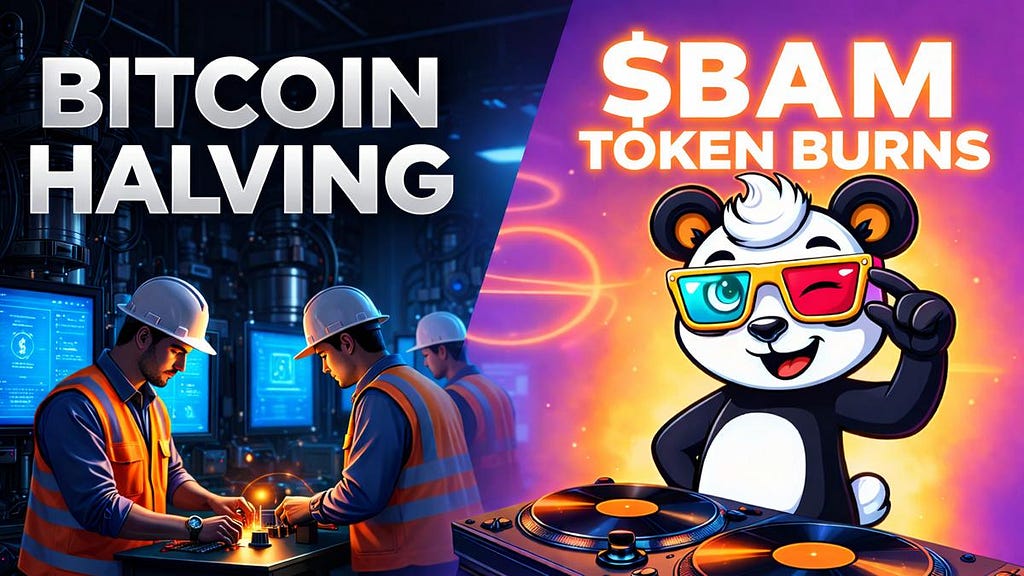
Mirroring Bitcoin’s Halving: How BAMBITZ ($BAM) Builds Lasting Scarcity Through Music Revenue Burns on Solana
In the world of cryptocurrency, few mechanisms have proven as enduring as Bitcoin’s halving events. Every four years, the reward for mining new blocks is slashed in half, creating a predictable scarcity that has underpinned BTC’s value proposition since its inception in 2009. The 2024 halving, which reduced the block reward from 6.25 to 3.125 BTC, sparked a market surge of over 20% in the subsequent months, reinforcing the power of deflationary economics.
But what if this scarcity model could be adapted beyond proof-of-work mining? Enter BAMBITZ ($BAM), a Solana-based memecoin that’s reimagining Bitcoin’s halving through a novel “Listen2Burn” mechanism, where real-world music revenue drives ongoing token burns. In a Solana ecosystem plagued by a 98%+ memecoin failure rate within three months, $BAM stands out as a utility-driven project blending crypto with the creator economy.
Launched in September 2025, BAMBITZ draws inspiration from Bitcoin’s core principles — fixed supply, decentralization and scarcity — while infusing them with the vibrancy of music and memes. As we approach the end of a turbulent year for altcoins, projects like $BAM offer a glimpse into how memecoins can evolve from hype machines into sustainable assets. This article explores $BAM’s tokenomics, its parallels to Bitcoin’s halving and why it could be a gem worth watching in 2026.
https://medium.com/media/1f6395ee8c7e5a4bed1ec9c56151c21d/href
Tokenomics Breakdown: Fair Launch and Deflationary Design
At its foundation, BAMBITZ emphasizes transparency and community ownership, much like Bitcoin’s no-premine genesis. The token boasts a fixed total supply of 1 billion $BAM, with no ongoing minting to dilute holders. This cap mirrors Bitcoin’s iconic 21 million coin limit, ensuring long-term scarcity without inflationary pressures. The distribution is notably fair: 76% allocated directly to the public and liquidity pools via a Jupiter launchpad on Solana, with the remaining 24% vested to the team for operations and development. Unlike many memecoins riddled with VC pre-sales or insider allocations, $BAM’s structure prioritizes decentralization from day one.
The star of the show, however, is the #Listen2Burn model, a revenue-backed burn engine that’s as innovative as it is practical. Here’s how it works: BambitzRecords.com, the music arm behind $BAM, generates royalties from streams on platforms like Spotify and others (Apple Music, Amazon Music etc.). Fifty percent of these earnings are funneled into buying back $BAM tokens from the open market and burning them permanently. This creates a deflationary loop where increased music engagement directly reduces the circulating supply.
Bambitz has hit 1,000 monthly Spotify listeners, a milestone that places it in the top 19% of all artists on the platform, where 81% never reach this level, according to @bambitzrecords X post.
Recent metrics underscore its effectiveness. Just three months post-launch, Bambitz has hit 1,000 monthly Spotify listeners — a milestone that places it in the top 19% of all artists on the platform, where 81% never reach this level. Tracks like “Never Compromised” and “Andy Andy” fuel this growth, with community-driven activities such as AMAs, dance challenges and X buzz amplifying streams. Solana’s ultra-low transaction fees (averaging $0.0001 post-2025 Firedancer upgrades) enable seamless “micro-burns”, allowing thousands of small transactions without prohibitive costs. As a result, $BAM’s supply tightens organically, rewarding holders with scarcity tied to real utility rather than speculative pumps.
Bitcoin Inspirations: Halvings Meet Dynamic Burns
The genius of $BAM lies in its adaptation of Bitcoin’s halving mechanics to a usage-based ecosystem. Bitcoin’s halvings are time-bound events: every 210,000 blocks (roughly four years), the issuance rate drops by 50%, culminating in zero new supply by 2140. This engineered scarcity has driven BTC’s narrative as “digital gold,” with each halving historically preceding bull runs.
$BAM flips this script by making scarcity dynamic and community-powered. Instead of fixed intervals, burns occur with every revenue cycle — royalty payouts act as “mini-halvings”, progressively eroding supply based on adoption. Both models achieve deflation through reduction: Bitcoin halves new issuance, while $BAM removes existing tokens from circulation. The outcome? Enhanced token value for long-term holders, as supply contraction meets steady or growing demand.
Consider the parallels in a side-by-side comparison:
This table highlights how $BAM borrows Bitcoin’s scarcity ethos but tailors it to Solana’s high-speed environment. While BTC’s halvings are rigid and miner-dependent, $BAM’s burns are adaptive — a viral track could trigger a burn surge equivalent to multiple halvings in weeks. Community involvement further aligns: Just as Bitcoin miners secure the chain, $BAM holders “mine” scarcity by streaming and promoting music, fostering a cult-like loyalty evident in X threads and AMAs.
Broader analyses of tokenomics support this approach. Fixed-supply models with burns, like those in Ethereum’s EIP-1559 or Bitcoin itself, consistently outperform inflationary tokens in volatile markets. In Solana’s memecoin landscape, where oversaturation led to an 83–93% drop in launch revenue in 2025, $BAM’s utility edge has enabled it to survive and thrive, defying the “meme apocalypse.”
Why It Matters Now: Solana’s Evolution and the Creator Economy
As we head into 2026, $BAM’s model couldn’t be more timely. Solana’s ecosystem upgrades, including Firedancer’s enhancements for sub-second finality and low-cost transactions, make micro-burns not just feasible but scalable. This aligns with broader trends in Web3, where creator economies are booming — music NFTs and royalty-sharing platforms raised over $500 million in funding in 2025 alone. $BAM bridges this gap, turning passive listeners into active stakeholders: Every play contributes to token burns, creating a flywheel of value accrual.
Moreover, in a post-halving Bitcoin era, alts like $BAM offer fresh narratives. With BTC’s next halving not until 2028, investors are seeking “halving analogs” in faster ecosystems. $BAM’s music tie-in adds cultural stickiness — panda-themed memes and Solana Breakpoint integrations (e.g. imagined collabs with Solana-branded guitars) amplify its appeal beyond charts.
https://medium.com/media/4c7fa547ca33cc5584e6674aefdb0f8e/href
Risks and Outlook: Balanced Growth in a Volatile Space
No project is without risks. Memecoins remain speculative and $BAM’s reliance on streaming revenue exposes it to platform changes (e.g. Spotify algorithm tweaks) or market dumps. Rug-pull fears persist in Solana, though $BAM’s fair launch and vested team allocations mitigate this. Broader crypto volatility — evident in Solana’s 70% launch volume drop earlier this year — could hinder adoption.
That said, the outlook is promising. With over 1,000 Spotify listeners and consistent burns, $BAM is positioned for exponential growth. If streams double in 2026, burn rates could accelerate, mimicking multiple Bitcoin halvings in a fraction of the time. Analysts peg utility memecoins as a 2026 trend, with $BAM’s model potentially inspiring copycats in gaming or content creation.
Conclusion: $BAM as Bitcoin Scarcity Remixed
BAMBITZ isn’t just another memecoin; it’s Bitcoin’s scarcity playbook remixed for the Solana age and the creator economy. By tying burns to tangible music revenue, $BAM transforms hype into lasting value, offering a blueprint for memecoins to mature. As Bitcoin continues to inspire the crypto world, projects like $BAM remind us that innovation thrives at the intersection of proven mechanics and real-world utility.
Mirroring Bitcoin’s Halving: How BAMBITZ ($BAM) Builds Lasting Scarcity Through Music Revenue… was originally published in Coinmonks on Medium, where people are continuing the conversation by highlighting and responding to this story.