
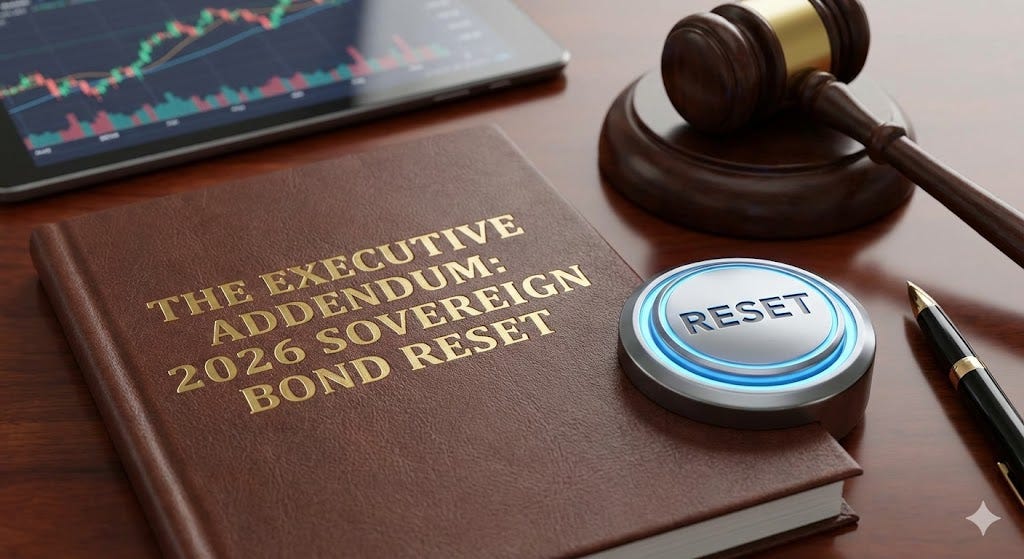
The Digital Bretton Woods: The Mathematical Inevitability of the Debt-Backed Dollar — Part 4 — Possible Scenarios
The 2026 Sovereign Bond Reset
1. The Strategic Context
If the previous volumes established the architecture of the new system — the $38.4 trillion US debt, the “Vampire Sponge” designed to fund it, and the “MSTR Blueprint” for escaping it — this addendum addresses the inevitable next phase: Implementation.
By early 2026, the theoretical frameworks are understood by global finance ministers. The question has shifted from “What is happening?” to “How do we survive it?” The “MicroStrategy model” — borrowing a depreciating currency to acquire a scarce asset — is no longer just a corporate tactic; it is being scrutinized as a potential instrument of national survival.
We are entering the era of the Sovereign Debt-for-Code Swap.
2. The Mechanism: The “Hard Asset” Sovereign Bond
For seventy years, developing nations have been trapped in a cycle of issuing dollar-denominated debt. They borrow strong dollars and have to pay them back with weak local currency, often leading to a “debt spiral” enforced by institutions like the IMF.
The “MSTR Blueprint” offers a radical inversion of this model. In 2026, we are likely to see the issuance of the first true Bitcoin-Backed Sovereign Bonds.
The Protocol
The Issuance: A sovereign nation issues a standard 10-year bond priced in US Dollars, offering a competitive interest rate (e.g., 8%).The Acquisition: Instead of using the proceeds to build roads or subsidize energy, the treasury immediately converts 100% of the USD proceeds into Bitcoin.The Collateralization: The Bitcoin is placed in a multi-signature, geo-distributed cold storage vault. This becomes the visible, auditable collateral for the bond.The Arbitrage: The nation now owes a fixed amount of “melting” dollars. They hold a fixed amount of scarce Bitcoin. If the Bitcoin price appreciates faster than the interest rate on the bond (a likely bet in a high-inflation USD environment), the nation’s balance sheet improves every day.The Geopolitical Insight: This is not just finance; it is a declaration of monetary independence. It transforms a nation from a “renter” of the dollar network into an “owner” of the Bitcoin network.
3. Case Study Alpha: The Desperate (e.g., Argentina, Turkey)
Nations experiencing chronic high inflation have the least to lose and the most to gain from this strategy. They are already drowning in dollar debt; the “Sponge” is already squeezing them dry.
For a country like Argentina (in this speculative scenario), the Sovereign Bond Reset is a Hail Mary. By issuing a Bitcoin-backed bond, they bypass traditional lenders who demand austerity. They appeal directly to the global capital markets that are hungry for Bitcoin exposure but restricted by mandates.
The Risk: If Bitcoin crashes, the country is insolvent.The Reality: They are already functionally insolvent under the dollar standard. The risk profile is asymmetric: certain slow death under the current system versus a chance at sovereign rebirth under a hard asset standard.
4. Case Study Beta: The Opportunist (e.g., UAE, Energy Exporters)
The dynamic changes for wealthy, energy-rich nations. They do not need the money. For them, the strategy is about Monetizing Energy and Hedging Geopolitical Risk.
These nations realize that selling oil for US Treasury bills (the old “Petrodollar” arrangement) is a losing trade when the Treasury bills are yielding less than real inflation. In 2026, we see the pivot toward the “Petro-Bitcoin” model.
The Strategy: Instead of buying US debt with excess oil profits, they mine or buy Bitcoin. They then issue bonds against this Bitcoin reserve to fund domestic diversification projects (like NEOM in Saudi Arabia or tech hubs in Dubai).The Leverage: This allows them to maintain liquidity without forcing them to hold the debt of a rival superpower (the US) that could sanction them at any moment. Bitcoin becomes neutral, apolitical collateral.
5. The Imperial Response: The Empire Strikes Back
The United States, faced with a $38.4 trillion debt that requires constant global funding, cannot afford to let the “Vampire Sponge” dry up. If sovereign nations stop buying Treasuries and start issuing their own Bitcoin bonds, the US bond market faces a catastrophic liquidity crisis.
Washington’s response in 2026 will likely be clinical and severe:
Financial Sanctions: The US Treasury may designate any sovereign bond backed by Bitcoin as a vehicle for “money laundering” or “evading sanctions,” effectively locking these bonds out of Western capital markets.The “Strategic Resource” Designation: The US may declare Bitcoin a strategic national resource, similar to uranium. This would allow the President to use emergency powers to restrict American companies (like BlackRock or Fidelity) from buying foreign sovereign Bitcoin bonds.The Final Conflict: The battle lines of 2026 are drawn between the US Treasury’s need for liquidity and the rest of the world’s need for sovereignty. The Dollar requires obedience; Bitcoin only requires verification.
6. Closing Synthesis: The Great Filter
The “2026 Sovereign Bond Reset” is the moment the world decides whether it wants to remain a passenger on the USS Titanic (the debt-based system) or build its own lifeboat (the collateral-based system).
The strategy is terrifyingly simple: Short the debt, long the code.
The nations that understand this arbitrage will become the new financial powerhouses of the 21st century. Those that cling to the old model, hoping the “Vampire Sponge” will spare them, will find themselves owning nothing but someone else’s unpayable promises.
Lingering Thought: When the music stops and the $38 trillion debt bill comes due, will your nation be holding the empty chair, or the immutable ledger?
The Digital Bretton Woods: The Mathematical Inevitability of the Debt-Backed Dollar — Part 4 —… was originally published in Coinmonks on Medium, where people are continuing the conversation by highlighting and responding to this story.